Endodontic Retreatment
Failed root canal recovery
Sometimes a tooth that received a root canal fails to heal, or becomes painful months or years after treatment. This can happen due to curved canals that were not fully cleaned, a delay in placing the crown, or new decay leaking under the restoration. Endodontic retreatment removes the old filling materials, re-cleans and sterilises the canals under high magnification, and places a new, hermetic seal to save the tooth.
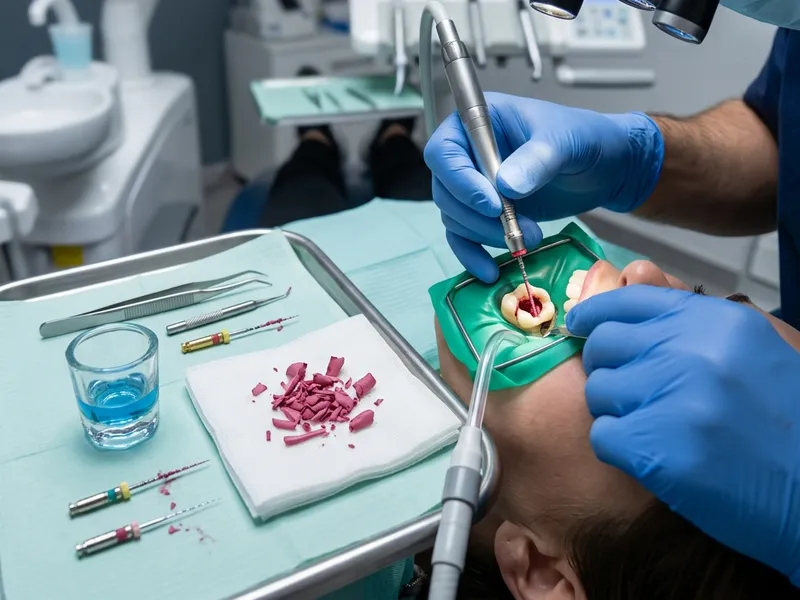
Microscopic retreatment specialists
Retreatment is clinically challenging and requires specialist skills. At Shwetha Dentistry, Dr Rashmi P. Patil uses surgical microscopes and specialised solvents to dissolve old fillings, locate previously missed canals and treat the infection successfully.
Old material removal
Safe dissolution and extraction of old gutta-percha and hard cements.
Missed canal detection
Locating extra canals that caused the first treatment to fail.
Advanced micro-disinfection
Targeted disinfection of resistant bacteria in failed canals.
Who is it for?
- Patients with persistent pain or swelling in a previously treated tooth
- Teeth with visible infections or bone lesions on X-rays after a root canal
- Failed root canals with loose, leaking or cracked crowns
- Cases with missed anatomy or incomplete sealing from a prior treatment
What to expect
Retreatment takes longer than a standard root canal because the old filling must be removed first. The tooth is completely numbed and the procedure is painless. It is typically completed in two visits, allowing an antibacterial paste to disinfect the canals between appointments.
Performed at Shwetha Dentistry by our specialist endodontic team.
The Procedure, Step by Step
Exactly what happens during your endodontic retreatment — no surprises.
Access & Crown Preparation
Access & Crown Preparation
Creating access through the old crown or restoration.
The endodontist creates an access opening. If the tooth has a crown, we may drill a small hole through it or remove the crown entirely to reach the pulp chamber and root canal openings.
This lets us reach the interior of the tooth and inspect the old treatment.
Old Material Removal
Old Material Removal
Dissolving and removing the old gutta-percha and cement.
Using specialised solvents and micro-instruments, the endodontist dissolves and extracts the old gutta-percha filling. Hard cements are gently loosened and removed using micro-ultrasonic tips.
Removing the old material is essential to clear the path for cleaning.
Canal Investigation
Canal Investigation
Searching for missed canals and errors under a microscope.
Under the microscope, the endodontist inspects the canals for missed anatomy, calcifications or errors (like ledges or perforations) from the first treatment.
Locating missed canals is the key to resolving the persistent infection.
Re-Disinfection & Dressing
Re-Disinfection & Dressing
Thoroughly cleaning and placing an antibacterial dressing.
The canals are cleaned, shaped and flushed with sanitising solutions. An antibacterial calcium hydroxide dressing is placed inside the canals and the tooth is sealed temporarily for 1 to 2 weeks.
The dressing works between visits to eliminate resistant bacteria.
Final Obturation
Final Obturation
Permanently sealing the clean canals with bioceramics.
During the second visit, the dressing is removed, the canals are flushed once more, dried, and permanently sealed with a bioceramic sealer and gutta-percha to prevent future contamination.
This new, hermetic seal protects the tooth and allows the bone to heal.
Treatment Cost
₹6,500 – ₹9,500
2 visits (60–80 minutes per visit)
Indicative range — please consult the dentist; the exact price varies from case to case.
Aftercare
- Avoid chewing on the tooth between visits and until it is crowned.
- Take prescribed anti-inflammatory relievers to manage minor post-operative soreness.
- Maintain standard oral hygiene with gentle flossing.
- Schedule a new, well-fitting crown once the retreatment is successful.
Frequently Asked Questions
Failures are usually caused by bacteria remaining inside the canal system — a missed canal, canals not fully cleaned due to curvature, a leaking crown, or new decay.
No. The tooth and surrounding tissues are fully numbed with local anaesthesia, so you feel no pain during the procedure, only mild pressure.
Saving your natural tooth is always the best option. Natural teeth chew better, maintain bone structure, and do not require expensive implants or bridges to replace.
Retreatment has a success rate of 75% to 90%, depending on the cause of failure, the complexity, and whether a microscope is used to locate hidden canals.
It ranges from ₹6,500 to ₹9,500 — slightly more than a standard root canal because it requires more time, specialist skills and solvents to remove old fillings. Please consult the dentist for an exact quote.
Usually two: the first to remove the old filling and place a disinfectant dressing, and the second to seal the canals.
If retreatment fails to resolve the infection, microsurgical options like an apicoectomy (root-end surgery) or extraction may be considered.
Yes. A new, well-fitting crown is essential to create a tight seal and protect the tooth from future leakage or fractures.
While some can, retreatments are highly complex and best performed by a specialist endodontist with the training and microscopes required.
Recovery is similar to a standard root canal. You may experience mild soreness for 2–3 days, which is managed with standard relievers.